Biogas English GTZ
Biogas Spanish GTZ
(the German Technical Cooperation (Deutsche Gesellschaft für Technische Zusammenarbeit, GTZ))
Thursday, 19 July 2012
Saturday, 14 July 2012
Science fair project : bio-waste biogas production
 |
| Courtesy, Ray Hull Human waste, from left, cow manure and food waste produce biogas next to a controlled environment in a science experiment led by California teens. The students found that food waste produced gas at the fastest rate. |
In May, three eighth-grade honors students from Santiago Charter Middle School in California completed a 21-day study of biogas generated from steer manure, human biosolids and food waste.
The experiment not only had a high gross factor, it earned the 14-year-old young researchers serious science credentials and a first place in the school's first science fair.
 Courtesy, Ray Hull From left, Charlie Hull, Bradley Warren and Justin Spitzer show off the blue ribbons they received for their project, “Biomass to Biogas,” in the Santiago Charter Middle School science fair. Charlie’s father, Ray Hull, is business manager for Central Region Landfills in Orange County, Calif.
"If we change the type of biomass [steer manure, human biosolids and food waste], then we will produce different amounts of biogas," the students said in their report. "Also, we predict food waste will produce the most biogas of the three biomasses."
Bingo!
The trio had measurable success with the experiment facilitated by Charlie's dad, Ray Hull, the business manager for Central Region Landfills, who helped them obtain their raw materials. They collected human biosolids liquid from the Orange County Sanitation District, food-waste slurry from Waste Management Inc. and fresh steer feces from Orange High School's stables.
"We went to [sciencebuddies.org] for ideas about experiments and we chose this because it had the 'ick' factor and involved renewable energy," Charlie said.
From there they donned protective clothing – a hazmat suit, particulate respirator mask, protective face shield and latex gloves – and put the materials into separate plastic bottles. Then they filled the bottles with distilled water to make them anaerobic and covered the mouth of each soda bottle with a rubber balloon to capture any biogas produced.
For the next 21 days, the boys visited the Hull laboratory – aka Charlie's garage – and measured the circumference of balloons in centimeters.
The results: Biogas from human biosolids filled three balloons to an average circumference of 9.16 centimeters. Cow manure filled three balloons to an average circumference of 8.45 centimeters. Food waste filled three balloons to an average circumference of 17.8 centimeters.
The interesting part, Charlie said, was that the steer manure and biosolids began producing biogas in a few days. The food waste sucked the balloons inside the bottle necks.
"On Day 17 and Day 18, the food waste balloons ripped," he said. The boys replaced the balloons and the food waste began generating biogas just two days later and in the end, generated the most biogas of the three biomasses.
The scientific conclusion: All three biomasses generated biogas, but that manure and biosolids generated biogas in an anaerobic environment, while food waste preferred an aerobic environment.
The academic conclusion: A+.
Led by teachers Kim Meier and Dorothy Yan, the biomass project was one of more than 100 science fair projects implementing the scientific method involving a hypothesis, independent and dependent variables, collecting data and presenting it graphically and formulating conclusions about results.
Each team had to give an oral presentation and create visual displays of its scientific findings. Projects were reviewed by more than 35 judges, including veteran scientists, area business professionals and educators.
"The hardest part was all the research ... and the materials were kind of nasty," said Bradley. "There weren't really any surprises; our hypothesis was supported by the data."

FLEXI-BIO GAS PLANT VIDEO
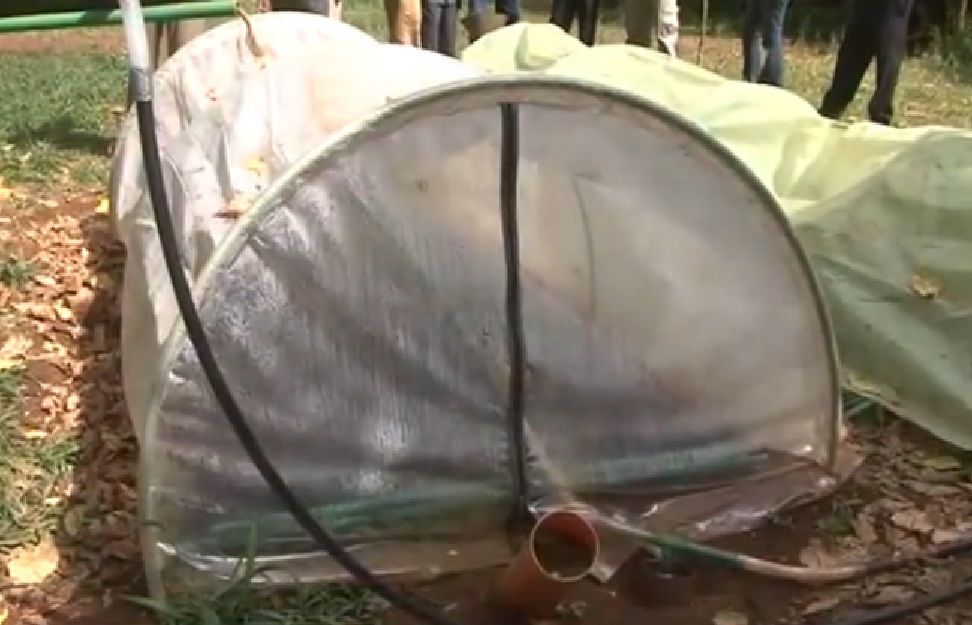
FLEXI-BIO GAS PLANT
WITH THE EVER SKY ROCKETING PRICES OF FUEL AND LIQUIFIED PETROLEUM GAS, KENYANS ARE SEEKING NEW WAYS OF EASING THE BURDEN AS MAJORITY STRUGGLE TO COPE WITH THE HARD ECONOMIC TIMES. A LOCAL NGO FLEXI BIOGAS INTERNATIONAL HAS COME UP WITH ONE WITTY INNOVATION ON PRODUCTION OF CHEAP, CLEAN AND ENVIRONMENT
FRIENDLY GREEN HOUSE GAS THAT PROMISES TO TURN THE WHEELS OF
DOMESTICALLY PRODUCED GAS FROM THE FORMER CONVENTIONAL.
 |
| FLEXI-BIO GAS PLANT |
WITH THE EVER SKY ROCKETING PRICES OF FUEL AND LIQUIFIED PETROLEUM GAS, KENYANS ARE SEEKING NEW WAYS OF EASING THE BURDEN AS MAJORITY STRUGGLE TO COPE WITH THE HARD ECONOMIC TIMES. A LOCAL NGO FLEXI BIOGAS INTERNATIONAL HAS COME UP WITH ONE WITTY INNOVATION ON PRODUCTION OF CHEAP, CLEAN AND ENVIRONMENT
FRIENDLY GREEN HOUSE GAS THAT PROMISES TO TURN THE WHEELS OF
DOMESTICALLY PRODUCED GAS FROM THE FORMER CONVENTIONAL.
Thursday, 28 June 2012
Video | High rate recovery of biowaste to biogas and biofertilizer
High rate recovery of biowaste to biogas and bio fertilizer
Saturday, 9 June 2012
Photos of Biogas Plant
Biogas Program with (SGAFP) Small Grants and Ambassador's Fund Program
 |
New method of cooking with biogas |
 |
Presentation of signboard |
 |
Biogas plant under construction |
 |
Laying the foundation of the biogas plant |
 |
Preparing for construction |
 |
Old method of cooking with wood or dung cakes |
 |
FIDA engineer inspecting the biogas plant |
Source:www.fidapk.org/photos/sgafpbiogas.html
Tuesday, 5 June 2012
Video | (Gobar Gas)Biogas plant of pakistan in tehsil jatoi Pakistan
Video | (Gobar Gas)Biogas plant of pakistan in tehsil jatoi Pakistan


Cooking on Biogas Video

I now approach the end of my Masters. In the past year I have been solely focusing on my project, the METABIN: a home bio-digester.
As part of the research I decided to make my own biogas out of food waste from the school’s canteen.
Just to clarify this bio-digester isn’t my actual design response it’s just a test piece to help me understand how Anaerobic Digestion works.
It seemed easy to get it going but it wasn’t. To make biogas you need to inoculate your digester with the right bacteria. After a few tries I managed to succeed using inoculum from another digester. Once the bacteria were happy and warm it was easy, peasy. I now have a steady gas production.
This video below shows the saga of biogas making: the initial trials, the retro-fitting of the digester, the inoculation, the cooking. And eating. (In case you are wondering, no, it doesn’t taste bad, and yes, I am still alive.)
Soon I will be posting more about the actual design project.
Thanks for watching!
Source:http://metabindigester.wordpress.com
Subscribe to:
Posts (Atom)